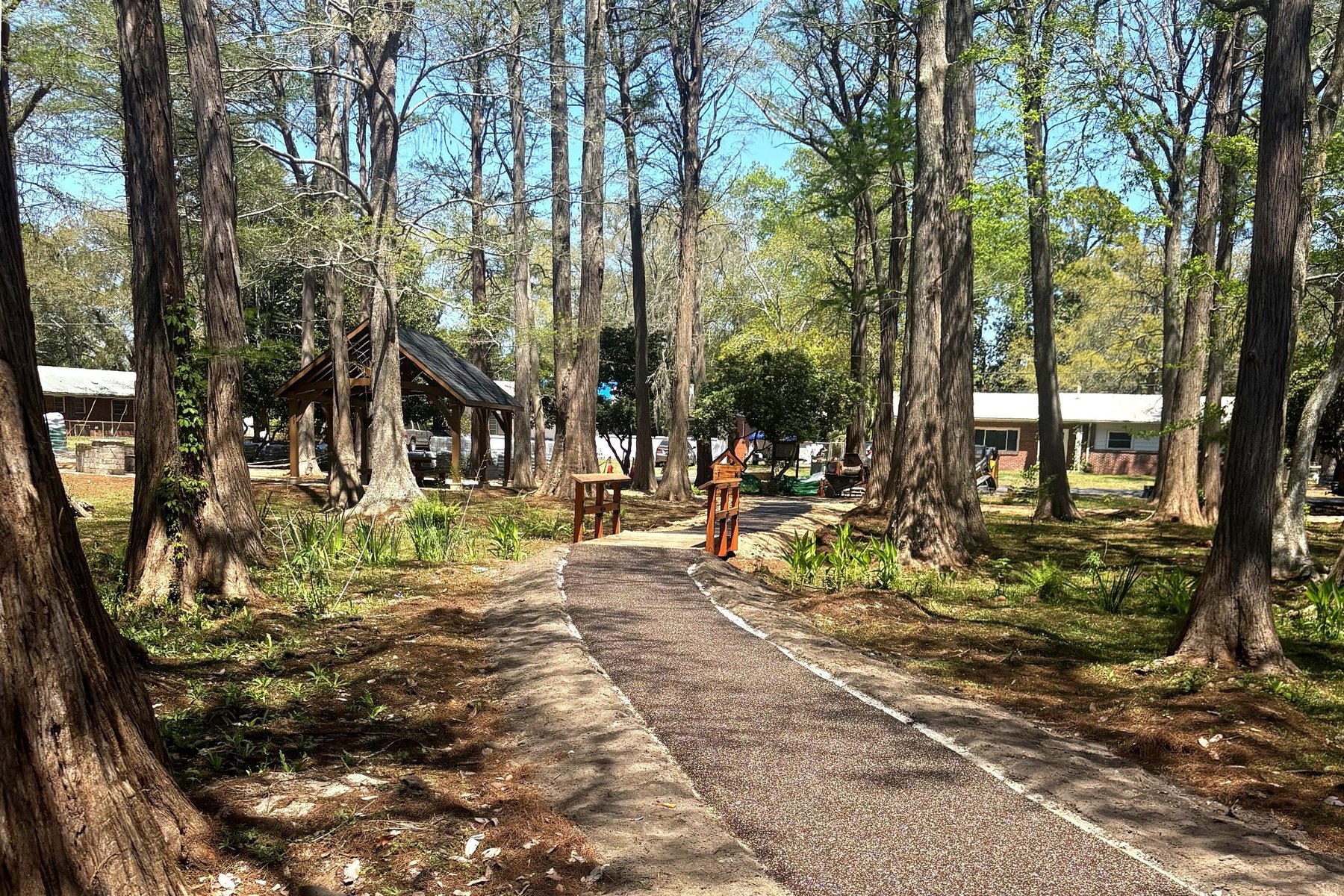
Porous pavement for pedestrian routes.
Continuous underfoot feel—without loose aggregate and without joints.
Full lab report is provided for technical review (methods, conditioning, specimen details). Request the lab report →
For design review, we ship a field-grade sample and align on fit and expectations before any field scope is scheduled.
Best suited to pedestrian routes where experience and operations matter.
Curated landscapes and collections
Gardens and arboreta where paths run through living collections and are expected to feel resolved,
accessible, and stable.
Guest environments
Zoos, nature centers, outdoor exhibits, and attractions where groups slow down and return—surfaces must
handle wet conditions and daily operations.
Institutional and campus grounds
Universities, museums, and civic environments where outdoor circulation is part of the public experience.
Courtyards and amenity paths
Where unit pavers or decorative patterning are not the intent, but the ground plane still needs material
character.
- Drainage and usability in wet conditions
- Joint-free access (wheelchairs, strollers, carts)
- A restrained, architectural surface read
- Maintenance planning over emergency patch cycles
- Lowest first cost is the only driver.
- Surfaces carry frequent heavy-truck traffic.
- The goal is decorative patterning or branded graphics.
If you’re unsure, send context—we’ll be candid.
A walking surface that stays out of the way.
Rigid pavements can feel hard and bright; loose aggregate shifts, tracks, and demands attention. EcoPave™ sits between those extremes: a monolithic surface with subtle resiliency underfoot, without the rattle and rolling of loose stone.
From a distance, the texture reads as a calm field that lets planting and architecture lead. Up close, it reads as a deliberate, finely graded surface—resolved but not decorative.
For visitors
Even, stable walking so focus stays on the collection, conversation, or view.
For accessibility
Wheelchairs, strollers, and carts move without loose material or vibration.
For operations
A surface that stays legible—without constant regrading, raking, and patchwork.
Want a quick “does this fit” review? Email a 4-line brief →
Familiar materials—assembled as a porous pavement system.
EP-200 combines specialty aggregate, recycled rubber granules, and an exterior-grade polyurethane binder to create an architectural porous pavement surface for pedestrian routes. Built for environments where water, planting, and seasonal change are daily realities.
Delivered with defined preparation and placement practices. Details can be calibrated for structured base conditions or more sensitive root and soil zones, depending on intent.
In higher-use corridors
Installed over a compacted aggregate base where structural stability and daily operations are primary
concerns.
In planted and naturalized areas
Detailed to protect roots and soils while maintaining a monolithic walking surface.
Measured performance for pedestrian-surface conditions.
EcoPave™ is most often evaluated alongside DG, porous asphalt, rigid pavements, or unit pavers—depending on the site and design intent. We prefer to review conditions rather than oversell a single metric.
Testing is performed by an independent laboratory. Reports include methods, specimen details, and conditioning so reviewers can interpret results appropriately.
If you’re in CDs or procurement, we provide the packet so the system can be evaluated on paper before any field commitment.
Lab report request
Share what you’re comparing against and what matters most (drainage, traction, maintenance, comfort). We’ll send the relevant report pages and sections.
Directional indicators for pedestrian routes. Refer to the report for methods, conditions, and applicability.
Results shown are from a specific specimen and conditioning; refer to the report for full procedure and applicability to your base and detail.
Sections, spec language, and the lab report.
Use these resources to evaluate EP-200 in your documents: sections, specification language, and the testing packet.
If you’re comparing options, tell us what’s on the shortlist (DG, porous asphalt, rigid pavements, unit pavers) and what matters most.
To keep packets current and ensure results are interpreted correctly, lab reports are distributed directly to reviewers.
As with any porous surface, performance depends on keeping fines and organics from accumulating. Typical care is periodic sweeping/blowing (or vacuum-sweeping where leaf litter and fines are persistent), edge/transition checks, and addressing localized damage promptly to prevent water bypass or undermining.
Not intended for vehicular roadways, heavy-truck service, or applications where lowest first cost is the sole selection driver.
If you only want a subset, request what’s relevant and we’ll keep it lean.
A field-grade sample for review.
Samples are produced with EP-200 constituents representative of the system’s material character and finish. Review alongside drawings, material boards, and comparable surfaces.
If you need data, tell us what matters most (drainage, traction, maintenance, comfort). We’ll send the relevant documents with context.
Request a sample with basic project context so we can respond thoughtfully.
We typically respond within a few business days with either shipment details or clarification questions.
Based in Atlanta. Supporting projects nationwide.
We work where landscape architecture, material performance, and construction overlap. We support design offices, institutions, and contractors with review, documentation, and execution planning aligned to intent.
Location: Atlanta, GA · Support: National
Contact
Email: info@ecopaveco.com
Phone: (404) 477-4722
Include: project type, location, timeline, and what you’re comparing against.